
Working as a dietitian for 15 years, I have had hundreds of people ask me about many different over-the-counter (OTC) weight loss products. Between the limited data on ingredients, confusing marketing, and expensive costs, my answer is generally the same – don’t waste your money.
I used to work alongside a clinical pharmacist, and I adopted his response to these kinds of questions – if a product worked really well, one of the pharmaceutical companies would have bought the rights to it already. If an OTC product seems too good to be true, it probably is.
Introducing Calocurb
When I got a sponsored e-mail from Today’s Dietitian about Calocurb, it felt a little different. While this publication does do sponsored e-mail blasts, they are generally from reputable companies. Today’s Dietitian is a publication that I know, like, and trust.
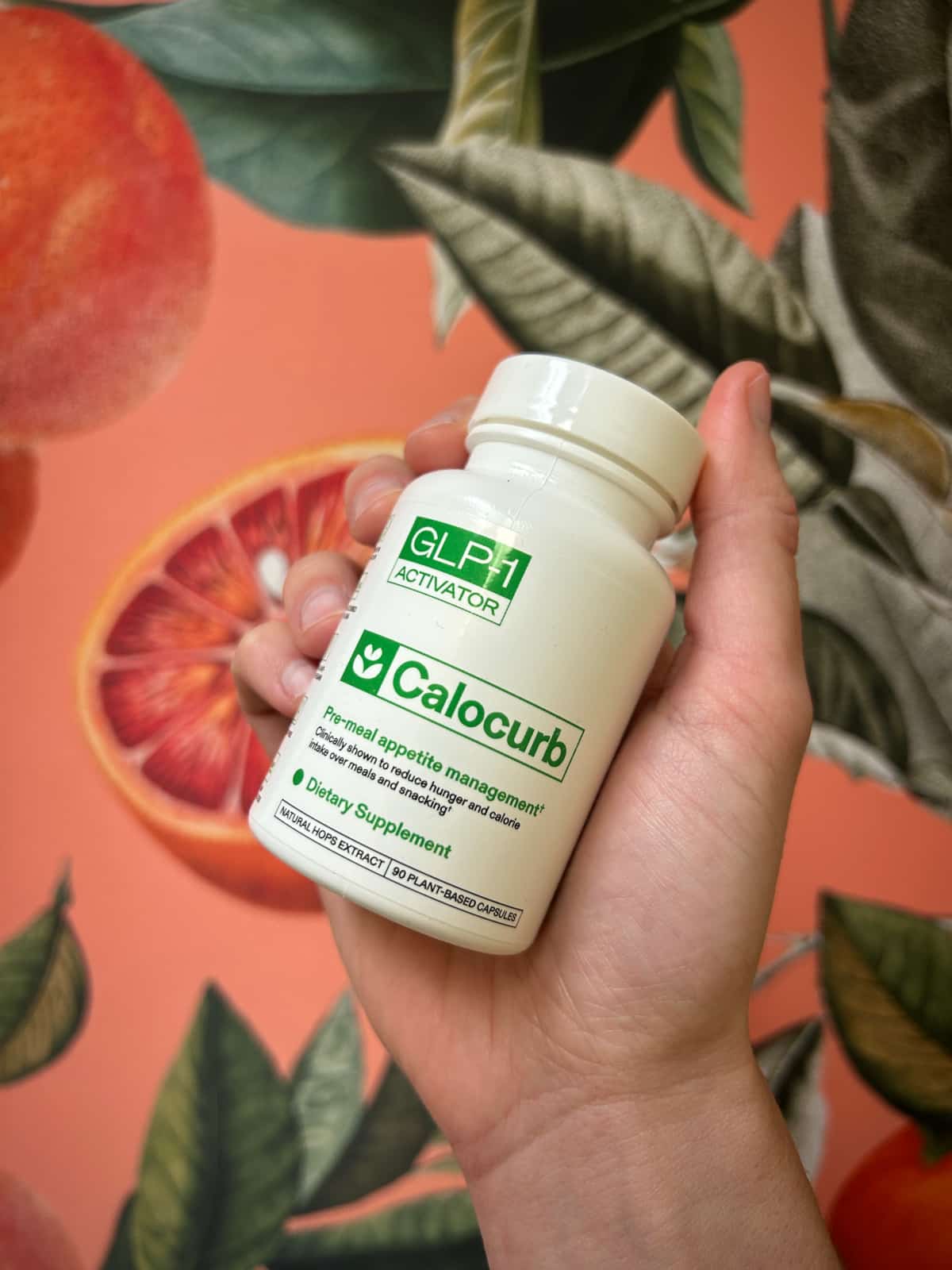
There have also been multiple clinical trials with Calocurb’s active ingredient, which is not typical with over-the-counter weight loss products. Some OTC products have ingredients with some data behind them, but they’re often not in doses that have been studied or heaven forbid it’s a “proprietary blend” (i.e. they literally won’t tell you how much of the ingredient is in the product). The Calocurb studies were done with doses that the product actually contains.
As part of this sponsored e-mail promotion, I was able to sign up to get a free sample. Before I knew it, there were 2 bottles of Calocurb at my doorstep. So to be clear, I received a free sample of this product, but I am in no way paid by the company to write this article.
Calocurb Ingredients: AmarasateⓇ
Calocurb describes itself as a GLP-1 activator that helps with appetite management. This dietary supplement contains three total ingredients:
- Amarasate – active ingredient
- Rosemary leaf extract – inactive ingredient, preservative
- Canola oil – inactive ingredient, excipient
Amarasate is a patented bitter hops extract from New Zealand that has been shown to help reduce appetite. Its proposed mechanism of action is actually quite fascinating. When bitter compounds interact with taste receptors on our tongue, we find the taste unpleasant and often spit it out or at least stop eating more. This is most likely a defense mechanism as poisonous plants are often bitter tasting.
Oddly enough, we also have taste receptors down further in our GI tract. They respond to bitter compounds by decreasing our appetite by the release of hormones such as GLP-1, CCK, and PYY. Calocurb is designed to take advantage of this process by releasing Amarasate directly into the duodenum, allowing it to stimulate the body’s natural production of these fullness-related hormones.
Potential Side Effects
Long-term side effects of Calocurb are unknown. Short-term side effects include GI symptoms including things like diarrhea and loose stool.
Calocurb Clinical Research
The Calocurb website references three studies on Amarasate stating that it reduces hunger, cravings and amount of calories consumed. Let’s go through each one:
Study of Healthy Men Doing a 24 Hour Fast
In the first study from 2019, 30 men of normal weight did a 24 hour water-only fast. They were provided either a placebo or a low or high dose of Amarasate the day of the fast. The participants’ hunger was assessed regularly during the day by using visual questionnaires asking questions such as, “how hungry do you feel?” and “how satisfied do you feel?”.
Both doses decreased hunger to a statistically significant value and the high dose increased feelings of fullness as well. Amarasate did not affect satisfaction or thoughts of food a statistically significant amount.
This study was a randomized, double-blind cross-over treatment study, so it’s of good quality, but it’s extremely small. It also looked at generally healthy men of normal weight, which may not reflect the typical user of this product.
Study of Healthy Women Doing a 24 Hour Fast
A similar study was done in 2024 in 30 women of normal weight doing a 24 hour water-only fast, and 27 of them completed all three parts of the study.
This study showed a decrease in hunger and food cravings with Amarasate. After the fast was over, the participants were provided a meal, and they consumed ~14% less calories at this meal after taking the high dose of Amarasate.
Again, this study was done in healthy women of normal weight, so it is unclear if women that are overweight or obese would respond similarly.
Study Looking at Delivery and Calories Consumed
The third Calocurb study was done on 19 men of healthy weight that took a placebo, Amarasate released into the stomach, and Amarasate released into the duodenum with at least a one-week washout period in between study arms. They were provided a breakfast in which they had to eat the entire meal, but then were provided a snack and lunch in which they were told to eat until they were comfortably full. Food intake was calculated and feelings of hunger and GI discomfort were assessed. Blood draws were also done to measure various gut hormone levels.
This study showed a ~17-18% decrease in calorie intake with Amarasate. It also showed an increase in hormones GLP-1, CCK and PYY and a decrease in insulin, GIP and pancreatic polypeptide.
While these results are promising, again, this was a very small study done in people of normal weight. It is unclear if the responses would be similar in people with obesity.
My Experience with Calocurb
When I first got the sample of Calocurb, I was still nursing my daughter, so I did not use the product right away. I offered it to my husband and he took it for a short period of time. He said he did not have any side effects and believed it possibly decreased his appetite. He did say, however, that it was hard to take at the right time, so he stopped bothering with it.
I was a little thrown off by the last part – in my head I was thinking that, yeah, you do have to make some sort of effort for the magic pill to work. How hard can it really be?
Many months later, I stopped nursing my daughter. I was struggling with a high appetite after being pregnant and breastfeeding for many years, and my weight had fluctuated a lot since having children – I thought it was the perfect time to try Calocurb.
I honestly was put off by the label “GLP Activator” on the bottle. While this is technically true, I felt like it was somewhat deceptive, making it seem like it is a GLP-1 medication, which it is not. I get it though – people are familiar with GLP-1s and are looking for less expensive alternatives.
When I opened the bottle, the smell was anything but appetizing. It was also surprising to see a yellow-colored oil through the clear capsule – not exactly enticing.

I took Calocurb as recommended, titrating the dose per the instructions. I did have one bout of diarrhea a few days in, which seems to be quite common with Calocurb. It seems somewhat strange to me that people seem to have this one-time bout and then don’t have it again, but again this appears to be common.
My appetite was already fluctuating quite a bit from day to day, so it was hard for me to assess if the product was actually decreasing my appetite or not. If I have to give an answer, I would have to say it did not.
I did find that I struggled just like my husband with taking Calocurb when I was supposed to. It is to be taken about an hour before a meal and should be taken on an empty stomach. Meeting both of these criteria was almost impossible for me. For example, I often eat lunch around 1:00 pm and have dinner around 6:30 pm, with a snack in between around 4:30 pm. So, when it was time to have the Calocurb at 5:30, I did not have an empty stomach. I also just often plain forgot – it was definitely harder than it sounds to get in the routine.
Criticism and Potential Concerns
Limited Data
While some of the results of the Calocurbs studies are promising, we have no long-term studies on safety and efficacy. There is also no data on how much weight people have actually lost on Calocurb. Prescription weight loss medications like Zepbound and Wegovy, on the other hand, have a significant amount of long-term data regarding safety, efficacy and effects on obesity-related comorbid conditions.
Natural Doesn’t Mean Safe
While Amarasate is a plant-based natural product, that does not mean it is any safer than medications like Zepbound or Wegovy. Supplements are not very well regulated, unlike prescription medications that have to go through rigorous testing before being approved.
Calocurb Is Not a GLP-1
Calocurb never claims to be a GLP-1 receptor agonist like Ozempic or Wegovy, but it does say “GLP Activator” on the bottle. While this is a truthful statement, I think some people might get the wrong impression and think these products work similarly when they do not. Calocurb stimulates the production of the GLP-1 your body already makes, while GLP-1 prescription medications are a synthetic form of the same hormone that lasts significantly longer in the body.
Cost
A monthly supply of Calocurb costs $89.99 and $76.95 if you sign up for a subscription. While people are willing to spend hundreds if not thousands of dollars on weight loss products, Calocurb’s cost is pretty steep. In comparison, another supplement marketed as a weight loss supplement, Berberine, goes for anywhere from ~$12-50 a bottle.
There are prescription weight loss medications that are only slightly more expensive than Calocurb. Qysmia is $98/mo out of pocket through a manufacturer program and Contrave is $99/mo through a similar program. These medications are FDA-approved medications shown to cause weight loss and have long-term data on both safety and efficacy.
Difficult Dosing
A medication or supplement is of little to no benefit if the patient is not taking it as recommended. While it sounds straightforward, the specific timing of this supplement can be a barrier to success. If users aren’t taking medication or supplements as prescribed, they’re not going to be as effective.
Maybe my husband and I are an anomaly and other people are better at taking their Calocurb regularly – I’m not sure. While we don’t have any data on patient adherence to Calocurb specifically, we do for the diabetes mediation Byetta, which is a prescription medication with similar dosing instructions. Byetta, the first prescription GLP-1 medication in the US, is to be taken twice daily, one hour before a meal. See the similarities?
In a 2013 retrospective real-world study, patients were ~11% more likely to be adherent with once-daily Victoza compared to twice-daily Byetta. I definitely saw this in clinical practice – I remember many patients saying they forgot to take Byetta regularly, even when they were very adherent with taking their other medications.
It seems like Calocurb is very well aware that people will not take it as recommended. While the instructions say to take a total of 4 capsules a day, a one-month supply only contains 90 pills, which is equivalent to less than a 23 days supply. The math just doesn’t add up here. I find it very odd that a company seems to expect that users will not take it as recommended.
Potential Use Cases
While Calocurb is not as effective and does not have the same data behind it as prescription weight loss medications, not everyone has access to prescription weight loss drugs. Many insurance companies are making it more and more difficult to get coverage for medications like Wegovy and Zepbound. Calocurb could be a potential option for people unable to get insurance coverage for prescription medications and cannot take Qysmia or Contrave for whatever reason.
Calocurb also markets itself as a way to get off of GLP-1 medications. While I don’t normally recommend people get off of these prescriptions, many patients are forced to due to ending insurance coverage. Many of these patients feel desperate and hopeless and are looking for anything that could potentially help. Even if it was a placebo-effect only, offering a product as a plan B may make some people feel more confident.
Overall Thoughts on Calocurb
As a dietitian in the weight management space, I personally am not strongly for or against this product. I think it is a better option compared to other over-the-counter weight loss products, but it by no means should be considered to be anywhere near the same level as prescription weight loss medications.
References:
New Zealand Bitter Hops Extract Reduces Hunger During a 24 h Water Only Fast